






DVD Recorders Explored
Thinking of getting a DVD recorder, and looking for some advice? FrequencyCast is an online radio show that discusses digital TV in the UK. We covered DVD recorders in depth in Show 20 of our podcast.
For more on digital TV, take a listen to our online show, or read through this page for some extra notes on buying and using a DVD recorder.
Listen to show 20, covering DVD Recorders:
|
Why you need a DVD Recorder
- No more VHS: The traditional VHS Video Cassette Recorder is a thing of the past - it's getting increasingly difficult to buy a new VCR, as most folk are now using DVD.
- Better quality: DVD offers much higher quality playback and recording than good old analogue videotape recorders.
- Archive: If you have a large collection of old VHS recordings on video tape - you might find that your tapes are degrading - magnetic tape goes 'funny' after years of storage, and mechanically, there's a lot that can go wrong with video cassettes. Dub those old recordings to DVD while you can. More info: Archiving your media.
- Share with friends: The V of DVD stands for Versatile - and DVDs are just that. You can store video, mp3, JPEG photos and computer data on a blank DVD, and share with your friends - much more flexible and shareable.
Getting a DVD Recorder
If you're interested in recording video onto DVD, there are two types of recorder:
- Separate: A stand-alone DVD recorder that hooks up to your telly, video and set-top box (pictured above)
- Computer: A computer DVD recorder that you can either install into your PC's case, or connect to you PC externally
For the purposes of this article, we're going to concentrate on the stand-alone DVD Recorder that you may connect to your main telly.
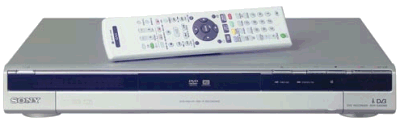
Sony RDRGXD360 DVD Recorder
What to look for in a DVD Recorder:
When buying a DVD recorder, here are the three top things to consider:
1. Digital vs Analogue
The UK's analogue TV service switched off in October 2012, meaning that most of the UK now gets its TV digitally, using one of the following services: via a TV aerial using Freeview, via a satellite dish (e.g. Sky), via cable (e.g. Virgin Media), or over the Internet
Most DVD recorders on the market now have a built-in digital receiver, but there are still some on the marked with analogue. A DVD recorder can record TV programmes in one of two ways:
- Digital TV via a TV aerial: You may know this better as "Freeview", and is received with a standard TV aerial. You need to be in a Freeview reception area to get Freeview (help), and have an aerial lead connected to your DVD recorder. DVD recorders with a digital receiver receive Digital TV.
Via a set-top box: As well as TV aerial inputs, DVD recorders can also record from other equipment, such as a set-top box or an old video recorder. Connection is made using a SCART lead. If you have Sky Digital, Virgin Media Cable, BT Vision or Top Up TV, you'll have a set-top box (also known as a digibox). You connect the output of your digibox to a DVD recorder using a SCART lead, then record from the digibox onto DVD via the SCART input, and not the TV aerial input. (help). DVD recorders with either an analogue or a digital receiver can connect to a set-top box.
... So, your choice comes down to getting a DVD recorder with an analogue or a digital receiver - two choices, as we explain below:
Our advice: Get a DVD Recorder with a digital receiver
Freeview offers Digital TV via a TV aerial. If you're in a Freeview coverage area and can get Freeview, then go for a DVD recorder with a digital TV receiver built-in. Look for the logo on the right. This will be able to record the Freeview channels (including the main 5 channels) via a TV aerial. It can also record from an old video recorder connected by SCART, as well as a digital set-top box (e.g. a Freeview set-top box, a Sky Digital Box, a Virgin Media box or a BT Vision v-box).
2. Hard disk recorder
DVR stands for Digital Video Recorder, and is essentially a hard-disk recording system. Services like Sky+, Virgin V+, BT Vision and Top Up TV Anytime already use a PVR, allowing you to record TV onto a hard-disk. You can now get DVRs with built-in DVD Recorders - These are great for allowing you to record lot of shows, and archive your favourites onto DVD if required. They're also DVD players, and many also can record Freeview meaning one box sitting below your telly, instead of three. We featured digital hard disk recorders back in Show 6
3. Choose a format
A little like VHS and Betamax, there are a few different DVD recording formats, and you need to be aware of which format to choose. See below for more on the different DVD formats.
Recommended DVD Recorders
SONY RDRGXD360
|
Freeview receiver, 8 day programme guide. Supports DVD+R , DVD+RW , DVD-R , DVD-RW as well as MP3 and JPG. Last time we checked, this was available from Currys for £199. |
|
DVD with Freeview receiver. 160 Gig drive. Hi-Def upscaler via HDMI socket. Available for around £250 from Currys |
|
DVD with Freeview receiver. 160 Gig drive. Hi-Def upscaler via HDMI socket. Supports
DVD, DVD-RAM, DVD-R/RW, DVD+R/RW, CD, CD-R/RW, VCD, SVCD, JPEG, MP3, for £230 Available from Currys for £290. |
Take a look at Currys and Argos for DVD Recorders.
DVD formats
Life is never easy, and to confuse everyone, there are several different DVD formats, as follows:| DVD format | Detail |
| DVD -R | These two formats are "write-once". Once you have recorded onto them, you can't add to, or erase, the contents. These play back in most DVD players |
| DVD +R | |
| DVD +RW | These two formats are re-recordable. You can re-record onto them up to 1000 times. |
| DVD -RW | |
| DVD RAM | Less common than the other formats. It's often used for data as it behaves like a hard-disk, but is also supported by some DVD recorders, and is quite versatile. Recordings on a DVD RAM disc are unlikely to play back in many DVD players |
| HD-DVD | The two competing High-definition formats. At the time of writing, no stand-alone domestic recorders exist - but you can burn to these forms from some PC DVD writers |
| Blu-Ray |
Commonly, blank DVDs have a capacity of 4.7Gig, equivalent to 2 hours of standard definition video. Our format of choice for compatibility, re-recordability and availability is the DVD+RW format - but if in doubt, look for a DVD recorder that can cope with multiple recording formats.
Blank disks cost around 90p each - but are a lot cheaper if you buy them without cases - you can buy 100 in bulk for less than 20p a disk.
Your DVD Recorder questions
| Recording from a digibox | If you want to record onto DVD from a Sky, Virgin or Freeview digibox, you'll need to connect the output of your digibox into one of the Line Input sockets on your DVD recorder. You'll typically do this using a SCART lead. Here's a quick guide on how to do this:
We've been asked if you need to look for an analogue or digital DVD recorder for recording from a Sky box - easy answer... it doesn't matter, as connecting via SCART doesn't make use of the DVD recorder's TV tuner. Given that the Digital Switch is approaching, it might be worth future-proofing, and going digital. |
| Archiving to DVD | For information on archiving your old video cassette tapes to DVD, see our Archiving your Recordings page, or take a listen to Show 21. |
| Digital DVD? | Site visitor Mark Barnes asks: "I have a TV with a integrated Freeview. Do I need a DVD recorder with digital?" If your TV can output Freeview via a SCART socket, you can connect it to a non-digital recorder, and record via the recorder's SCART line-in. The limitation here is that you can only record whatever your TV is tuned in to. If you were to get a DVD recorder with a built-in Freeview receiver, you've be able to record a different Freeview channel to the one you're watching on your TV. |
| DVD and HDD | Three questions on combined DVD, Freeview and hard-disk recorders from site visitor Susan Slater. She says: "My son wants a DVD recorder that has built in Freeview and a hard disk." "Would he be able to watch a Freeview program whilst recording another Freeview program on another channel? (As you can with the old VHS recorders)".
"Presumably you can record a Freeview program whilst watching a DVD film?".
"Are there any implications/problems with say buying this new item and linking it with an old TV?"
|
| DVD +R and DVD-D | A question from listener Neil Fulcher: "Listened to your report on DVD recorders with interest (Show 20). There is clearly a difference between DVD-R, and DVD+R. What is it, and is it worth worrying about?" DVD-R was developed as a DVD format by Pioneer, and DVD+R by an alliance that included Philips and Sony. DVD-R got their first. Whilst there is a technical difference, from a practical level, there's not a lot to worry about - Both formats can be played by around 90% of DVD players, you just need to make sure you buy the right discs for your recorder. For example, if your recorder can only burn DVD-R discs, don't buy a box of blank DVD+D discs. For more on this subject, try this article. |
 On the DVD recorder remote control, you'll need to select the Line In / Ext / AV channel into which you've connected the SCART lead from the Sky box.
Other links
Got a question on DVD Recorders that we can answer in our next podcast?
Call 020 8133 4567 or send us a message
Share This Page:


