Looking to record audio on the move? Here’s our guide to the tools available
Recording audio on the move?

On this page, we look at a collection of tools used for capturing voices.
Recording – A History Lesson:
Let us take a brief look at the history of recording. In the beginning we scratched out an analogue recording in the form of the wax cylinder, many thanks to our friend Mr Edison.


By replacing virtually all the initial components, and some more than once, whilst maintaining the original design, well roughly anyway, we eventually achieved the modern day turntable or ‘decks’ as known to the trendier man.

Other developments in sound recording and playback were also being developed in the form of recording on magnetic tape, however these were analogue.
Now, we’re in a digital age and recording has changed considerably. Grab yourself a byte on the bit, and let’s look at the ways you can record in high quality on the move.
Portable recording

Things improved with the launch of the D.A.T. (Digital Audio Tape recorder). The plan was that D.A.T may one day overtake the Walkman market offering a a high quality portable recording device, but recorders were generally too expensive for the domestic market, and failed to catch the attention of the masses.
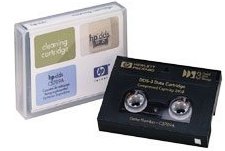
DAT – Digital Audio Tape

D.A.T hardware was mainly used and bought by journalists and other audio professionals, and the consumer market opted for Minidisc, and now, MP3 devices such as the iPod, mainly though convenience and cost. The audio captured by Minidisc and mp3 is compressed – meaning that the recordings leave out details within the encoding process, to keep file sizes low.
So, with D.A.T and tape dead, and Minidisc using heavy compression, what are the options for recording ‘linear’ (i.e. uncompressed’) high-quality audio? Bring on the Olympus LS-11…
Olympus LS-11 Recorder
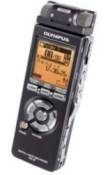
Olympus, chiefly know for their cameras, also produce a range of office Dictaphone voice recorders. We’ve reviewed one of these in the past, the Olympus DS-30.
These are great for recording hour of conference audio, office notes, meetings, and even medium quality audio for use on podcasts.
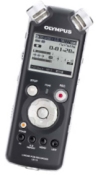

Looking like an over-sized Dictaphone, a strange mobile phone, or even some sort of stun gun or tazer, these are, in fact, the future of high quality pocket recording devices. They can record linear stereo audio, with no compression, are easy to use in the field and can hold over 50 hours of audio. You can copy off your recorded audio to a PC, and use an editing package (CuBase Le4 is included) to chop up your recordings, add music and effects, and create an audio masterpiece. You can use the built-in stereo mics, connect in your own mic, or even record using the line-level audio input socket.
We’ve put together a full review of these two devices – See our Olympus LS-10 and LS-11 Review
 |




Other Options
A few other portable recording options:
|
Handheld Dictaphones
See our Olympus VN-8500PC review or our Olympus DS-30 review. Also see Amazon‘s collection of voice recorders. |
Recording Pen
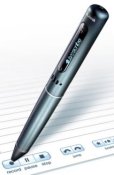
See our LiveScribe Pulse SmartPen review
|
|
Mobile Phone Audio
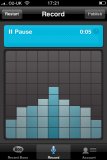
The application AudioBoom, running on Apple’s iPhone is the mobile tool of choice for Citizen Journalists. |
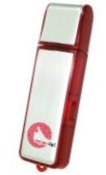
USB Recorders
This and other recorders are available from Amazon. |




Ten reasons to replace your recorder:
For years, our Carl has been recording audio on a portable DAT recorder. We think we’ve won him round to using a portable digital device – the Olympus LS-11. Here are his reasons for making the switch:
- It’s smaller than my D.A.T recorder.
- It’s lighter than my D.A.T recorder.
- It has no moving parts.
- The Olympus LS-11 has its own built-in stereo microphones
- The Olympus LS-11 has its own built-in monitor speakers.
- You don’t need tapes to record.
- The LS-11 only requires 2 AA batteries.
- The sound recorded has the option of a higher frequency response.
- D.A.T technology is over 15 years old.
- The pre-amp on my DAT machine’s left channel has gone!
Got a question on portable recording? Contact us and we’ll try to help
More information
- DIY Podcast – Our page of information on how to make your own podcast.
- Record your own voice – A feature on home recording and editing
- MP3 and MP3 Players – Information on the MP3 format