Archive article – running costs updated October 2026
This article originally accompanied FrequencyCast Show 30 and features measurements of equipment from the late 2000s and early 2010s. The appliance models, measured power consumption and usage assumptions have been retained for historical reference, but the electricity costs have been recalculated using Ofgem’s October–December 2026 average electricity unit rate of 26.32p/kWh. These are illustrative estimates, not fresh measurements or forecasts of electricity prices for the whole of 2026. Your tariff and actual usage will differ.
Curious about the cost of powering your PVR, set-top box, Home Hub and other household equipment?
We covered watts and power consumption in Show 30. We’d encourage you to take a listen to the MP3 of the show.
As promised in the show, here’s a handy table of costs, plus some tips on how to bring down your electricity bills.
Listen to our audio feature covering Watts, Power Consumption and Energy:  |
Cost of running appliances and gadgets
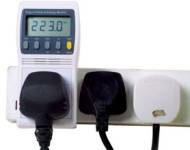
Interested in estimating how much power older home technology and appliances could cost at 2026 electricity rates? The original article used a standard power meter to identify the cost of running your gadgets and equipment.
Important: The calculations treat each listed wattage as constant during the stated usage time. Real appliances such as kettles, washing machines and fridges cycle on and off, so their actual energy consumption can be very different. For an accurate figure, measure energy use in kWh with a suitable plug-in meter.
Household appliances
| Product | Notes | Watts | Cost per hour (2026) | Daily usage (hours) | Estimated annual cost (2026) |
|---|---|---|---|---|---|
| 60 watt lightbulb | Standard bulb | 60 | £0.0158 | 5 | £28.82 |
| Energy-saving bulb (Philips) | Equivalent to a standard 60 w bulb | 11 | £0.0029 | 5 | £5.28 |
| Kettle | Average kettle 1800 watts | 1800 | £0.4738 | 0.25 | £43.23 |
| Washing Machine | Average cycle (2000w heat, 500w spin, 250 wash) | 700 | £0.1842 | 2 | £134.50 |
| Fridge | Average fridge consumes 35 watts | 35 | £0.0092 | 24 | £80.70 |
Computing
This page was actually put together as a result of a stack of requests to find out how much power the BT Home Hub uses, and how much it costs to run this router each year. Here are some numbers for the Home Hub and other computing gadgets.
| Product | Notes | Watts | Cost per hour (2026) | Daily usage (hours) | Estimated annual cost (2026) |
|---|---|---|---|---|---|
| LCD Monitor | 17″ Sony | 75 | £0.0197 | 8 | £57.64 |
| Desktop PC | Average 60w idle, 120 loaded | 90 | £0.0237 | 8 | £69.17 |
| Router – BT Home Hub v1.0 / 1.5 | wi-fi enabled | 8 | £0.0021 | 24 | £18.45 |
| Router – BT Home Hub v2.0 | 10 watts (7 watts powersave) | 10 | £0.0026 | 24 | £23.06 |
| Homeplug Powerline adapter | D-link Ethernet Devolo Hs85 | 3 | £0.0008 | 24 | £6.92 |
| Printer (idle) | Estimated 3w | 3 | £0.0008 | 24 | £6.92 |
TV and Video
| Product | Notes | Watts | Cost per hour (2026) | Daily usage (hours) | Estimated annual cost (2026) |
| TV – LCD (Sony Bravia KDL32S3000) | When on | 115 | £0.0303 | 4 | £44.19 |
| On standby | 0.6 | £0.000 | 20 | £0.48 | |
| PVR (Humax PVR9200TB) | When on | 20 | £0.0053 | 4 | £7.69 |
| On standby | 6 | £0.001 | 20 | £4.76 | |
| Sky+ (Thomson 160) | When on | 24 | £0.0063 | 4 | £9.22 |
| On standby | 12.2 | £0.001 | 20 | £9.67 | |
| BT Vision Box | When on | 22 | £0.0058 | 4 | £8.45 |
| On standby | 21 | £0.002 | 20 | £16.64 | |
| Top Up TV Anytime (Thomson DTI-6300) | When on | 18.2 | £0.0048 | 4 | £6.99 |
| On standby | 17.3 | £0.002 | 20 | £13.71 | |
| DVD Recorder (SONY RDRGX120) | When on | 17 | £0.0045 | 4 | £6.53 |
| On standby | 3.5 | £0.000 | 20 | £2.77 |
Other Equipment
| Product | Notes | Watts | Cost per hour (2026) | Daily usage (hours) | Estimated annual cost (2026) |
|---|---|---|---|---|---|
| Nokia mobile charger | Nokia 6033, screen on | 4 | £0.0011 | 24 | £9.22 |
| iPhone 3G charger | Charging with screen off | 2 | £0.0005 | 24 | £4.61 |
How these results are calculated:
The original measurements have been repriced using the published 2026 Ofgem average electricity unit rate:
2026 electricity rate: 26.32p per kWh (£0.2632/kWh), the Ofgem average for Great Britain, standard variable tariff, Direct Debit, 1 October–31 December 2026. Source: Ofgem.
Original article: Based on Scottish Power Fixed Price (London), 10.857p per kWh, last checked 1 August 2011.
Method: Watts ÷ 1,000 × £0.2632 × hours used. Annual figures assume the same daily usage for 365 days. Standing charges are excluded because these are normally paid regardless of whether an individual appliance is used. Actual prices vary by region, payment method and tariff. The 2026 rate is valid for the stated quarter, not necessarily the whole year.
How to calculate the cost of equipment usage:
It’s easiest to take the example of the good old 60 watt electric lightbulb.
How many watts? 60. The watt is a measurement of power – so you can say 60 watts of power are required to make this lightbulb light up.
The measurement of watts is only meaningful when calculating cost, if you use watt-hours (how much to light the bulb for an hour).
Your electricity provider will bill you by the kilowatt-hour (kWh), and that’s what your electricity meter records.
A 60 watt lightbulb left switched on for one hour is equal to 0.06 kWh (divide 60 watts by 1000 to get the kW) – so you multiply 0.06 kWh by your provider’s kWh price, to get the cost.
Example: 60 watt bulb for one hour = 0.06 kWh × £0.2632 = £0.0158 (about 1.58p).
| Listen to our audio feature covering Watts, Power Consumption and Energy: |
Recommended Products:
Want to keep an eye on your kilowatt-hours? We recommend the following meters:
|
|
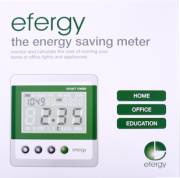 Efergy Energy Saving Meter
Your questions answered
Q. Does a shaver socket use power when there’s nothing plugged in?
If you have a shaver socket that uses an isolation transformer (most do), and it doesn’t have an on-off switch (most don’t), then yes, the shaver socket will use a minimal amount of power (we estimate 1 or 2 watts) when there’s nothing plugged in.
Q. How much does it cost to recharge batteries?
After a question from a listener in Show 60 – We finally solved the “are rechargeable batteries cheaper?” question. See our Rechargeable vs Normal Batteries maths